Absolute Magnitude Space
What the instrument actually returned, before the conversion that became the headline.
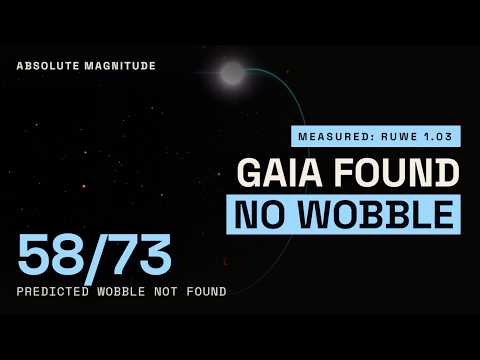
Betelgeuse's Six-Year Cycle May Not Be Its Companion
Betelgeuse's companion was predicted from a six-year cycle in the star's light, and a faint point turned up where it was predicted. Three months earlier, a Gaia study of 224 giants...

Betelgeuse's Companion Has Four Published Masses
In December 2024 the SPHERE camera on ESO's Very Large Telescope recorded a faint point 52.32 milliarcseconds from Betelgeuse, about 1,200 times fainter than the star. Since then t...
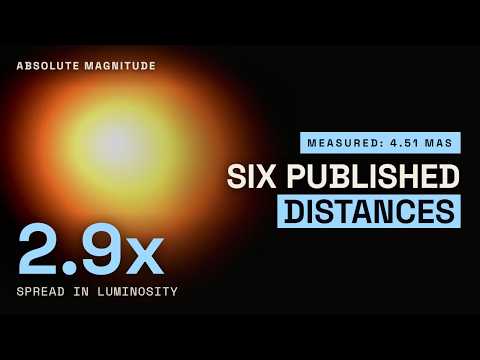
Betelgeuse Is 10 Times Wider Than Its Own Parallax
Betelgeuse has been given six published distances in thirty years, from 131 to 222 parsecs, and every one of them is a measurement. What the instrument returns is an angle of about...

Betelgeuse Lost Two Thirds of Its Light. One Number Was Measured.
In the winter of 2019-2020 Betelgeuse faded to visual magnitude 1.614, about 36% of its usual light, and the headlines said it was about to explode. The photometer returned one bri...

S301: The Fastest Star in the Galaxy Has Two Orbits
S301 falls past the Milky Way's black hole at 25,000 km/s, eight per cent of the speed of light, every 8.7 years. No instrument has measured that speed. The discovery paper has nin...

S2 Weighed Sagittarius A* Four Times and Got Four Answers
The mass of the Milky Way's black hole is quoted to a quarter of one per cent, from one star's sixteen-year orbit. The same team has published it four times since 2018, each to und...

Sagittarius A* Moved While the Telescope Was Looking
The same eight telescopes, the same five nights of April 2017, two black holes. One picture took two years. The other took five, and the delay was in the object rather than in the ...

The Event Horizon Telescope Never Took a Photograph
The famous orange ring is not a photograph, and no instrument in the array ever recorded an image. Eight telescopes recorded arrival times; two conversions did the rest.

12,500 Red Giants Caught Gaia Overcorrecting Itself
Every star with a convective envelope is ringing right now. This episode measures distance by listening to that ring, never once touching a parallax -- and uses it to catch a space...

Nobody Has Ever Measured the Distance to a Galaxy
Every distance beyond about three thousand parsecs was calculated, not measured. There is exactly one rung of the ladder that is pure geometry, and it is very short.

The Star That Shrank by a Third (and nobody took a new photo)
UY Scuti is the largest star you have ever been told about: 1,708 times the radius of the Sun. That number was never measured. What was measured is an angle.